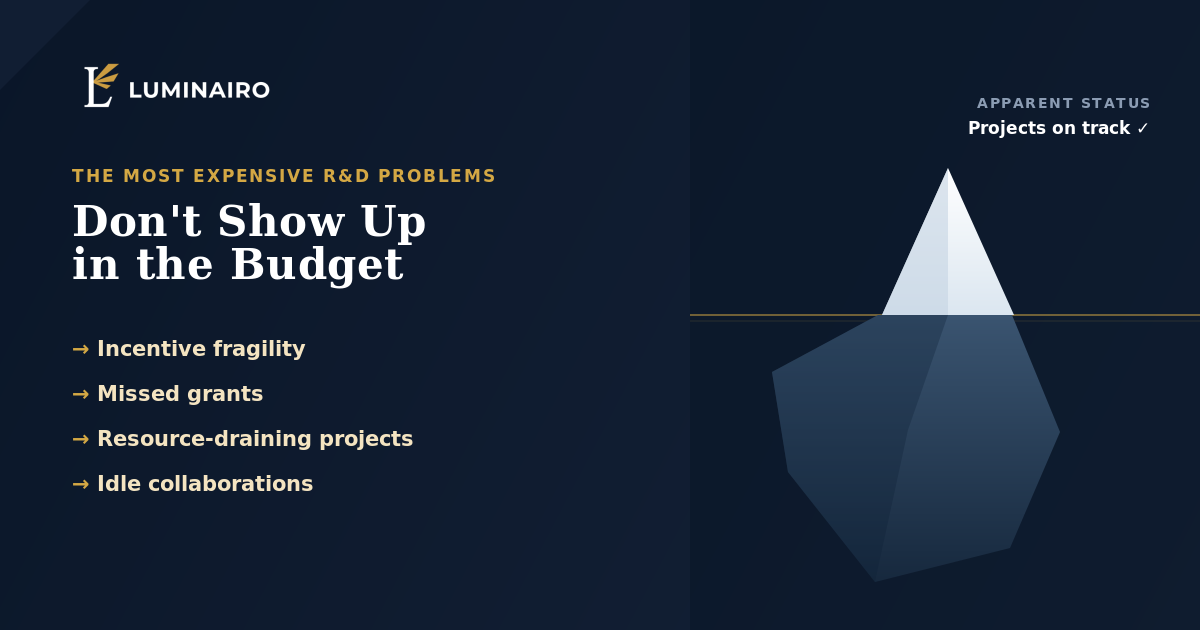
An R&D organization manages what it can see. The audit date is known, so you prepare. Budget approval comes on a calendar. The report deadline is in everyone's diary. Visible problems share one trait: they have a trigger that moves you in time.
The real cost sits in the problems with no trigger. Because no alarm goes off, they can run for years and often cost more than the visible problems combined. The four below are the silent costs we see most often — in R&D portfolio health, funding capture, the technology roadmap, and collaborations. This article names them and frames their cost; it is about why a diagnosis is needed, not the solution.
1. Funding left on the table
Some projects in an R&D portfolio, matched to the right call at the right time, qualify for partial support from national or international funding programs. But the match never happens on its own. A call opens, offers a short application window of a few weeks, and closes without ever hitting anyone's radar.
The cost is simple to compute: the share of a project you were going to run anyway, now paid out of your own pocket because no one applied. A single missed grant on a mid-sized project can easily exceed the cost of external support. This money never looks like a "loss" — because it never arrived. And because it never arrived, no one goes looking for it.
2. Resource-draining projects
Every mature portfolio carries projects that made sense the day they started but live on today only through inertia. They consume budget and person-months, but their strategic return is gone. No one stops them — because stopping is a decision, while continuing is just "what's happening."
The cost isn't only the budget that project absorbs — it's the high-value project that resource could have gone to. Carrying two resource-draining projects often means failing to finance the next leap. It never shows up anywhere as "waste"; it shows up as "in progress."
This is not an outsider walking in and saying "kill that project." That decision is made with the organization's own data and team. What an outside view can do is make the low-value, high-resource cluster visible. The rest is the organization's call.
3. Roadmap blind spots
A technology roadmap quietly ages. Capability gaps that are expensive to carry internally — AI, autonomy, electrification, digitalization — stay hidden behind a roadmap that no longer reflects where the field is going. The targeted technologies drift out of date, and the missing ones are never named.
The cost is twofold: the capability you can't deliver on time, and the leap a competitor makes while your roadmap stands still.
4. Idle collaborations
University–industry partnerships and consortium agreements usually start with a signed protocol, stay alive through the first year, then survive only on paper. The capability gaps named above — the ones that are expensive to close internally — could often be closed far more cheaply through the right partner, but the option stays invisible behind a protocol nobody has looked at since it was signed.
The cost is twofold: the collaboration you pay for but never use, and the capability you could have reached through it but never do.
What these four share
None of them comes from a bad decision. They come from decisions no one realized they were making. An un-stopped project is a decision. A missed call is a decision. Carrying an aging roadmap is a decision. Keeping an idle partnership on paper is a decision. The trouble is, no one knows they made it.
You can't manage, price, or fix what you can't name. The total an R&D organization leaves on the table is usually the sum of these silent items — and they're almost never seen side by side in a single report.
Before you can fix something, you have to see where it is. How to fix it is the next step.
Clarifying the picture first
Your visible dashboard may be spotless. The real question is: what's on the invisible side? Seeing the current state of these areas in one place — with their size and priority — is almost always cheaper than learning it in a closed funding window or a missed leap.
The R&D Portfolio Diagnostic: see the current state in one picture
The Luminairo R&D Portfolio Diagnostic is a fixed-scope diagnostic that makes the risks and opportunities across portfolio health, funding potential, your technology roadmap, and collaborations visible in a single picture within two weeks. Not a solution — a clear diagnosis of where your problems and opportunities are.
Explore the Diagnostic →This article is for general information only and does not constitute financial or legal advice.